
sexta-feira, 3 de junho de 2011
what we do every singel day in this planet

Find your way

The giant panda

The panda is a conservation reliant endangered species.A 2007 report shows 239 pandas living in captivity inside China and another 27 outside the country Wild population estimates vary; one estimate shows that there are about 1,590 individuals living in the wild,while a 2006 study via DNA analysis estimated that this figure could be as high as 2,000 to 3,000. Some reports also show that the number of pandas in the wild is on the rise. However, the IUCN does not believe there is enough certainty yet to reclassify the species from Endangered to Vulnerable.While the dragon has historically served as China's national emblem, in recent decades the panda has also served as an emblem for the country. Its image appears on a large number of modern Chinese commemorative silver, gold, and platinum coins. Though the panda is often assumed to be docile, it has been known to attack humans, presumably out of irritation rather than predation.
sábado, 28 de maio de 2011
The Bald Eagle
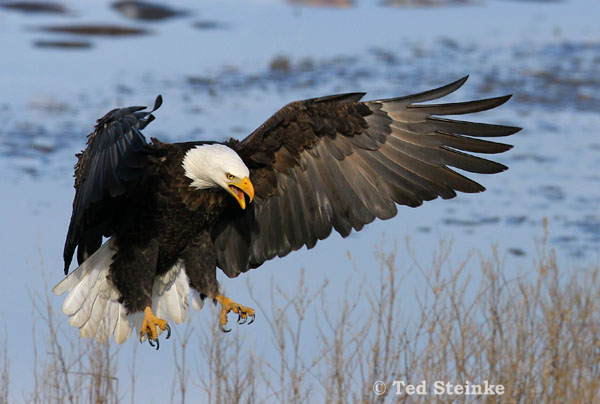
The Bald Eagle (Haliaeetus leucocephalus) is a bird of prey found in North America. It is the national bird and symbol of the United States of America. This sea eagle has two known sub-species and forms a species pair with the White-tailed Eagle. Its range includes most of Canada and Alaska, all of the contiguous United States, and northern Mexico. It is found near large bodies of open water with an abundant food supply and old-growth trees for nesting.
In the late 20th century the Bald Eagle was on the brink of extirpation in the continental United States, while flourishing in much of Alaska and Canada. Populations recovered and stabilized, so the species was removed from the U.S. federal government's list of endangered species and transferred to the list of threatened species on July 12, 1995, and it was removed from the List of Endangered and Threatened Wildlife in the Lower 48 States on June 28, 2007.
Bald Eagles are not actually bald. The name derives from the older meaning of the word, "white headed".The plumage of an adult Bald Eagle is evenly brown with a white head and tail. The tail is moderately long and slightly wedge-shaped. Males and females are identical in plumage coloration, but sexual dimorphism is evident in the species in that females are 25 percent larger than males.[The beak, feet, and irises are bright yellow. The legs are feather-free, and the toes are short and powerful with large talons. The highly developed talon of the hind toe is used to pierce the vital areas of prey while it is held immobile by the front toesThe beak is large and hooked, with a yellow cereThe plumage of the immature is brown, speckled with white until the fifth (rarely fourth, very rarely third) year, when it reaches sexual maturity.Immature Bald Eagles are distinguishable from the Golden Eagle in that the former has a more protruding head with a larger beak, straighter edged wings which are held flat (not slightly raised) and with a stiffer wing beat, and feathers which do not completely cover the legsThe Bald Eagle is a large bird, with a body length of 70–102 centimeters (28–40 in), a wingspan of between 1.68 m (66 in) and 2.44 m (96 in), and a mass of 2.5–7 kilograms (5.5–15 lb); females are about 25 percent larger than males, adult females averaging 5.8 kilograms (13 lb) and males averaging 4.1 kilograms (9.0 lb)The size of the bird varies by location; the smallest specimens are those from Florida, where an adult male may barely exceed 2.3 kilograms (5.1 lb) and a wingspan of 1.8 m (5.9 ft). The largest are Alaskan birds, where large females may exceed 7.5 kilograms (17 lb) and have a wingspan of over 2.4 m (7.9 ft)Its diet consists mainly of fish, but it is an opportunistic feeder. It hunts fish by swooping down and snatching the fish out of the water with its talons. It is sexually mature at four years or five years of age. In the wild, Bald Eagles can live up to thirty years, and often survive longer in captivity.[The Bald Eagle builds the largest nest of any North American bird, up to 4 meters (13 ft) deep, 2.5 meters (8.2 ft) wide, and one metric ton (1.1 tons) in weightThe call consists of weak chirping whistles, harsher and more shrill from young birds than adults.The average lifespan of Bald Eagles in the wild is around 20 years, with the oldest living to be about 30. In captivity, they often live somewhat longer. In one instance, a captive individual in New York lived for nearly 50 years. As with size, the average lifespan of an eagle population appears to be influenced by its location.
The tree

A tree is a perennial woody plant. It is most often defined as a woody plant that has many secondary branches supported clear of the ground on a single main stem or trunk with clear apical dominanceA minimum height specification at maturity is cited by some authors, varying from 3 m to 6 m;some authors set a minimum of 10 cm trunk diameter (30 cm girth).Woody plants that do not meet these definitions by having multiple stems and/or small size are called shrubs. Compared with most other plants, trees are long-lived, some reaching several thousand years old and growing to up to 115 m (379 ft) high.Trees are an important component of the natural landscape because of their prevention of erosion and the provision of a weather-sheltered ecosystem in and under their foliage. They also play an important role in producing oxygen and reducing carbon dioxide in the atmosphere, as well as moderating ground temperatures. They are also elements in landscaping and agriculture, both for their aesthetic appeal and their orchard crops (such as apples). Wood from trees is a building material, as well as a primary energy source in many developing countries. Trees also play a role in many of the world's mythologies (see trees in mythology).
sexta-feira, 29 de abril de 2011
The crocodile

Member species of the family Crocodylidae are large aquatic reptiles that live throughout the tropics in Africa, Asia, the Americas and Australia. Crocodiles tend to congregate in freshwater habitats like rivers, lakes, wetlands and sometimes in brackish water. They feed mostly on vertebrates like fish, reptiles, and mammals, sometimes on invertebrates like molluscs and crustaceans, depending on species. They are an ancient lineage, and are believed to have changed little since the time of the dinosaurs. They are believed to be 200 million years old whereas dinosaurs became extinct 65 million years ago; crocodiles survived great extinction events.The word crocodile comes from the Ancient Greek κροκόδιλος (crocodilos), "lizard," used in the phrase ho krokódilos ho potamós, "the lizard of the (Nile) river."
There are several variant Greek forms of the word attested, including the later form κροκόδειλος (crocodeilos)found cited in many English reference works In the Koine Greek of Roman times, crocodilos and crocodeilos would have been pronounced identically, and either or both may be the source of the Latinized form crocodīlus used by the ancient Romans.
Crocodilos/crocodeilos itself is a compound of krokè ("pebbles"), and drilos/dreilos ("worm"). It is ascribed to Herodotus, supposedly to describe the basking habits of the Egyptian crocodile.However the worddrilos is only attested as a colloquial term for "penis".The meaning of krokè is explained as describing the skin texture of lizards (or crocodiles) in most sources,but is alternately claimed to refer to a supposed habit of (lizards or crocodiles) basking on pebbly ground.The form crocodrillus is attested in Medieval Latin.It is not clear whether this is a medieval corruption or derives from alternate Greco-Latin forms (late Greek corcodrillos and corcodrillion are attested).
A (further) corrupted form cocodrille is found in Old French and was borrowed into Middle English as cocodril(le). The Modern English form crocodile was adapted directly from the Classical Latin crocodīlus in the 16th Century, replacing the earlier form.
The use of -y- in the scientific name Crocodylus (and forms derived from it) is a corruption introduced by Laurenti (1768). Crocodiles are similar to alligators and caiman; for their common biology and differences between them, see Crocodilia.
Crocodiles, like dinosaurs, have the abdominal ribs modified into gastralia.
Crocodiles are among the more biologically complex reptiles despite their prehistoric look. Unlike other reptiles, they have a cerebral cortex; a four-chambered heart; and the functional equivalent of a diaphragm, by incorporating muscles used for aquatic locomotion into respiration (e.g. M. diaphragmaticus); Their external morphology on the other hand is a sign of their aquatic and predatory lifestyle. A crocodile’s physical traits allow it to be a successful predator. They have a streamlined body that enables them to swim swiftly. Crocodiles also tuck their feet to their sides while swimming, which makes them faster by decreasing water resistance. They have webbed feet which, although not used to propel the animal through the water, allow it to make fast turns and sudden moves in the water or initiate swimming. Webbed feet are an advantage in shallower water where the animals sometimes move around by walking.
Crocodiles have a palatal flap, a rigid tissue at the back of the mouth that blocks the entry of water. The palate has a special path from the nostril to the glottis that bypasses the mouth. The nostrils are closed during submergence. Like other archosaurs, crocodilians are diapsid, although their post-temporal fenestrae are reduced. The walls of the braincase are bony but they lack supratemporal and postfrontal bones Their tongues are not free but held in place by a membrane which limits movement; as a result, crocodiles are unable to stick out their tongues.
Crocodilian scales have pores that are believed to be sensory, analogous to the lateral line in fishes. They are particularly seen on their upper and lower jaws. Another possibility is that they are secretory, as they produce an oily substance that appears to flush mud off.
Crocodiles are very fast over short distances, even out of water. Since crocodiles feed by grabbing and holding onto their prey, they have evolved sharp teeth for tearing and holding onto flesh, and powerful muscles that close the jaws and hold them shut. These jaws can bite down with immense force, by far the strongest bite of any animal. The pressure of the crocodile's bite is more than 5,000 pounds per square inch (30,000 kPa), compared to just 335 pounds per square inch (2,300 kPa) for a rottweiler, 400 pounds per square inch (2,800 kPa) for a large great white shark, 800 pounds per square inch (6,000 kPa) to 1,000 pounds per square inch (7,000 kPa) for a hyena, or 2,000 pounds per square inch (10,000 kPa) for a large alligator. The jaws are opened, however, by a very weak set of muscles. Crocodiles can thus be subdued for study or transport by taping their jaws or holding their jaws shut with large rubber bands cut from automobile inner tubes. They have limited lateral (side-to-side) movement in their neck.
quarta-feira, 27 de abril de 2011
The cheetah

This article is about the animal. For other uses, see Cheetah. The cheetah (Acinonyx jubatus) is an atypical member of the cat family (Felidae). It is the fastest of all cats, but lacks strong climbing abilities. The species is the only living member of the genus Acinonyx. It is the fastest land animal, reaching speeds between 112 and 120 km/h (70 and 75 mph)[3][4] in short bursts covering distances up to 500 m (1,600 ft), and has the ability to accelerate from 0 to over 100 km/h (62 mph) in three second. The Cheetah's are also very addapted to the habitat they live in
The tarsiers
For the past 45 million years, tarsiers have inhabited rainforests around the world, but now they only exist on a few islands in the Philippines, Borneo and Indonesia. In Bohol, the Philippine Tarsier was a common sight in the southern part of the island until the 1960s. Since then, the number has dwindled to as few as an estimated 1000 still left in the wild.[citation needed] Once protected by the humid rainforests and mist-shrouded hills, these mysterious primates struggle to survive as their home is cleared for crop growing.
Due to the quickly growing human population, which causes more and more forests to be converted to farmland, housing areas and roads, the place where the Philippine Tarsier can live its secluded life is disappearing.
Along this line, the dwindling of Philippine forests has posed a grave and significant threat to the survival of the Philippine Tarsier because this results in the destruction of its natural forest habitat. Indiscriminate and illegal logging, cutting of trees for firewood, "kaingin" or slash and burn method of agriculture, urbanization patterns have encroached on the habitats of the tarsier, causing the tarsier to be threatened or endangered.
The unabated hunting of the species by humans for house pets or for trade has contributed to its decline as well. Hunting tarsiers to sell as pets was a thriving industry until recently. Because of its adorable and benign appearance, many have been lured to keep the Philippine Tarsier as pets. This demand fuels the capture and illegal trade of the animal further diminishing its remaining number.[citation needed] Moreover, the life span for wild tarsiers is 24 years, but often as little as 12 years in captivity. Aside from the issues of replicating a natural diet, climate, and exercise that may reduce a captive tarsier's lifespan, stress may be added by the fact that many human owners want to interact with and display their pets by day, interrupting their nocturnal lifestyle.[citation needed]
Paradoxically, indigenous superstition coupled with relatively thick rainforest, particularly in Sarangani province, have apparently preserved this endangered species. Indigenous tribes leave the Philippine Tarsiers in the wild because they fear that these animals could bring bad luck. One belief passed down from ancient times is that they are pets belonging to spirits dwelling in giant fig trees, known as belete trees. If someone harms a tarsier they need to apologize to the spirits of the forest, or it is thought they will encounter sickness or hardship in life.
Due to the quickly growing human population, which causes more and more forests to be converted to farmland, housing areas and roads, the place where the Philippine Tarsier can live its secluded life is disappearing.
Along this line, the dwindling of Philippine forests has posed a grave and significant threat to the survival of the Philippine Tarsier because this results in the destruction of its natural forest habitat. Indiscriminate and illegal logging, cutting of trees for firewood, "kaingin" or slash and burn method of agriculture, urbanization patterns have encroached on the habitats of the tarsier, causing the tarsier to be threatened or endangered.
The unabated hunting of the species by humans for house pets or for trade has contributed to its decline as well. Hunting tarsiers to sell as pets was a thriving industry until recently. Because of its adorable and benign appearance, many have been lured to keep the Philippine Tarsier as pets. This demand fuels the capture and illegal trade of the animal further diminishing its remaining number.[citation needed] Moreover, the life span for wild tarsiers is 24 years, but often as little as 12 years in captivity. Aside from the issues of replicating a natural diet, climate, and exercise that may reduce a captive tarsier's lifespan, stress may be added by the fact that many human owners want to interact with and display their pets by day, interrupting their nocturnal lifestyle.[citation needed]
Paradoxically, indigenous superstition coupled with relatively thick rainforest, particularly in Sarangani province, have apparently preserved this endangered species. Indigenous tribes leave the Philippine Tarsiers in the wild because they fear that these animals could bring bad luck. One belief passed down from ancient times is that they are pets belonging to spirits dwelling in giant fig trees, known as belete trees. If someone harms a tarsier they need to apologize to the spirits of the forest, or it is thought they will encounter sickness or hardship in life.
The casuar
The cassowary (Casuarius spp.) Is a bird of the ratite group of large birds, native to northeastern Australia, New Guinea and surrounding islands.
The three species of cassowary Casuariidae belong to the family and are with the ostrich and Emu, the largest birds in existence today. The preferred habitat of the cassowary are areas of rainforest, where there is a large number of trees available to produce the fruits that they feed. In this environment the cassowary plays an important ecological role in dispersing seeds of trees. The cassowary is an important figure in the mythology of the native populations of Oceania and generally represents a mother figure.
The plumage of the cassowary is abundant and greyish in color, with colored feathers at the base of the neck. These birds have a red crest on top of the head, which grows slowly during the first year of the animal and with unknown function. The group has no significant sexual dimorphism, with females only slightly larger and more colorful. A distinctive feature is the presence of a claw-shaped dagger finger in this procedure. As in other strutioniformes, cassowaries have stunted wings and three toes on each foot.
The cassowary is a bird agile, which can run about 50 mph and jump 1.5 m without any balance. Animals are usually shy and quiet but they may be extremely aggressive and dangerous for humans to protect the nest or their young.
During breeding males claim a territory and try to attract a female, it remains only to lay between 3-5 eggs. After laying the female leaves the nest and may breed in another country. The males alone take care of nests and offspring during the next nine months. Juveniles are brownish in color and just make a typical adult plumage at about three years.
The cassowary is a bird important to humans for hundreds of years as a source of protein through meat and eggs. Some tribes in New Guinea have a habit of robbing the nests and rear their young to adulthood, when sold or killed for local consumption, however the cassowary has never been completely tamed. The colorful feathers are also a source of interest and the reason in the past the European settlers hunted the animal thoroughly. Currently, three species of cassowary are threatened by habitat destruction and are protected by law. It is a bird more dangerous to humans because their kick can equate the same force of a small knife, and may even sever a limb.
Various species of cassowary are abundant in the fossil record of the Plio-Pleistocene Australia and is thought to have evolved from emus somewhere in the Miocene.
The three species of cassowary Casuariidae belong to the family and are with the ostrich and Emu, the largest birds in existence today. The preferred habitat of the cassowary are areas of rainforest, where there is a large number of trees available to produce the fruits that they feed. In this environment the cassowary plays an important ecological role in dispersing seeds of trees. The cassowary is an important figure in the mythology of the native populations of Oceania and generally represents a mother figure.
The plumage of the cassowary is abundant and greyish in color, with colored feathers at the base of the neck. These birds have a red crest on top of the head, which grows slowly during the first year of the animal and with unknown function. The group has no significant sexual dimorphism, with females only slightly larger and more colorful. A distinctive feature is the presence of a claw-shaped dagger finger in this procedure. As in other strutioniformes, cassowaries have stunted wings and three toes on each foot.
The cassowary is a bird agile, which can run about 50 mph and jump 1.5 m without any balance. Animals are usually shy and quiet but they may be extremely aggressive and dangerous for humans to protect the nest or their young.
During breeding males claim a territory and try to attract a female, it remains only to lay between 3-5 eggs. After laying the female leaves the nest and may breed in another country. The males alone take care of nests and offspring during the next nine months. Juveniles are brownish in color and just make a typical adult plumage at about three years.
The cassowary is a bird important to humans for hundreds of years as a source of protein through meat and eggs. Some tribes in New Guinea have a habit of robbing the nests and rear their young to adulthood, when sold or killed for local consumption, however the cassowary has never been completely tamed. The colorful feathers are also a source of interest and the reason in the past the European settlers hunted the animal thoroughly. Currently, three species of cassowary are threatened by habitat destruction and are protected by law. It is a bird more dangerous to humans because their kick can equate the same force of a small knife, and may even sever a limb.
Various species of cassowary are abundant in the fossil record of the Plio-Pleistocene Australia and is thought to have evolved from emus somewhere in the Miocene.
The ligers
The liger (lion + tiger) is a hybrid between a lion and a tigress.
Males are sterile hybrids of this animal, because the number of chromosomes of the lion and tiger are pairs, but different, so the liger has an odd number of chromosomes through the process of meiosis that occurs in the formation of male and female gametes (eggs and sperm, respectively), can mate with another animal with similar characteristics, as the tiger or lion pure, but their offspring may have the delicate health.
His appearance is a giant lion with diffused tiger streaks. He is currently the largest feline in the world, with between 3.5 and 4 meters in length. With only three years might weigh half a ton, through their diet of meat and chicken.
It is believed that the sheer size that these animals grow to occur by the absence of genes that determine the production of hormones growth inhibitors. That's because this is a lion in the maternally inherited, and the Tigers is the father, so ligers do not get those genes. The cross between lions and tigers only occurs by action of man. In addition to the habits of both species are very different, they usually do not share the same territories, so there are few opportunities to come together to form this strange intersection. Currently only those animals coexist in nature in the Gir forest, India. Previously however, lions and tigers have coexisted in Mesopotamia, the Caucasus, Persia, Afghanistan and in much of the Indian subcontinent.
Males are sterile hybrids of this animal, because the number of chromosomes of the lion and tiger are pairs, but different, so the liger has an odd number of chromosomes through the process of meiosis that occurs in the formation of male and female gametes (eggs and sperm, respectively), can mate with another animal with similar characteristics, as the tiger or lion pure, but their offspring may have the delicate health.
His appearance is a giant lion with diffused tiger streaks. He is currently the largest feline in the world, with between 3.5 and 4 meters in length. With only three years might weigh half a ton, through their diet of meat and chicken.
It is believed that the sheer size that these animals grow to occur by the absence of genes that determine the production of hormones growth inhibitors. That's because this is a lion in the maternally inherited, and the Tigers is the father, so ligers do not get those genes. The cross between lions and tigers only occurs by action of man. In addition to the habits of both species are very different, they usually do not share the same territories, so there are few opportunities to come together to form this strange intersection. Currently only those animals coexist in nature in the Gir forest, India. Previously however, lions and tigers have coexisted in Mesopotamia, the Caucasus, Persia, Afghanistan and in much of the Indian subcontinent.
The raccon
For other species called raccoon in the genus Procyon, see ProcyonFor other uses, see RaccoonThe raccoon sometimes spelled as racoonalso known as the common raccoonorth American raccoonnorthern raccooand colloquially as coon
is a medium-sized mammal native to North America. It is the largest of the procyonid family, having a body length of 40 to 70 cm (16 to 28 in) and a body weight of 3.5 to 9 kg (8 to 20 lb). The raccoon is usually nocturnal and is omnivorous, with a diet consisting of about 40% invertebrates, 33% plant foods, and 27% vertebrates. It has a grayish coat, of which almost 90% is dense underfur, which insulates against cold weather. Two of its most distinctive features are its extremely dexterous front paws and its facial mask, which are themes in the mythology of several Native American tribes. Raccoons are noted for their intelligence, with studies showing that they are able to remember the solution to tasks up to three years later.
The original habitats of the raccoon are deciduous and mixed forests of North America, but due to their adaptability they have extended their range to mountainous areas, coastal marshes, and urban areas, where many homeowners consider them to be pests. As a result of escapes and deliberate introductions in the mid-20th century, raccoons are now also distributed across the European mainland, the Caucasus region and Japan.
Though previously thought to be solitary, there is now evidence that raccoons engage in gender-specific social behavior. Related females often share a common area, while unrelated males live together in groups of up to four animals to maintain their positions against foreign males during the mating season, and other potential invaders. Home range sizes vary anywhere from 3 hectares for females in cities to 50 km2 for males in prairies (7 acres to 20 sq mi). After a gestation period of about 65 days, two to five young (known as a "kit", plural "kits") are born in spring. The kits are subsequently raised by their mother until dispersion in late fall. Although captive raccoons have been known to live over 20 years, their average life expectancy in the wild is only 1.8 to 3.1 years. In many areas hunting and traffic accidents are the two most common causes of death.
is a medium-sized mammal native to North America. It is the largest of the procyonid family, having a body length of 40 to 70 cm (16 to 28 in) and a body weight of 3.5 to 9 kg (8 to 20 lb). The raccoon is usually nocturnal and is omnivorous, with a diet consisting of about 40% invertebrates, 33% plant foods, and 27% vertebrates. It has a grayish coat, of which almost 90% is dense underfur, which insulates against cold weather. Two of its most distinctive features are its extremely dexterous front paws and its facial mask, which are themes in the mythology of several Native American tribes. Raccoons are noted for their intelligence, with studies showing that they are able to remember the solution to tasks up to three years later.
The original habitats of the raccoon are deciduous and mixed forests of North America, but due to their adaptability they have extended their range to mountainous areas, coastal marshes, and urban areas, where many homeowners consider them to be pests. As a result of escapes and deliberate introductions in the mid-20th century, raccoons are now also distributed across the European mainland, the Caucasus region and Japan.
Though previously thought to be solitary, there is now evidence that raccoons engage in gender-specific social behavior. Related females often share a common area, while unrelated males live together in groups of up to four animals to maintain their positions against foreign males during the mating season, and other potential invaders. Home range sizes vary anywhere from 3 hectares for females in cities to 50 km2 for males in prairies (7 acres to 20 sq mi). After a gestation period of about 65 days, two to five young (known as a "kit", plural "kits") are born in spring. The kits are subsequently raised by their mother until dispersion in late fall. Although captive raccoons have been known to live over 20 years, their average life expectancy in the wild is only 1.8 to 3.1 years. In many areas hunting and traffic accidents are the two most common causes of death.
The dodo
As with many animals that have evolved in isolation from significant predators, the dodo was entirely fearless of people, and this, in combination with its flightlessness, made it easy prey for humans. However, journals are full of reports regarding the bad taste and tough meat of the dodo, while other local species such as the Red Rail were praised for their taste. When humans first arrived on Mauritius, they also brought with them other animals that had not existed on the island before, including dogs, pigs, cats, rats, and Crab-eating Macaques, which plundered the dodo nests, while humans destroyed the forests where the birds made their homes; the impact these animals—especially the pigs and macaques—had on the dodo population is currently considered to have been more severe than that of hunting. The 2005 expedition's finds are apparently of animals killed by a flash flood; such mass mortalities would have further jeopardized a species already in danger of
becoming extinct.
Although there are scattered reports of mass killings of dodos for provisioning of ships, archaeological investigations have hitherto found scant evidence of human predation on these birds. Some bones of at least two dodos were found in caves at Baie du Cap which were used as shelters by fugitive slaves and convicts in the 17th century, but due to their isolation in high, broken terrain, were not easily accessible to dodos naturally.
There is some controversy surrounding the extinction date of the dodo. Roberts & Solow state that "the extinction of the Dodo is commonly dated to the last confirmed sighting in 1662, reported by shipwrecked mariner Volkert Evertsz" (Evertszoon), but many other sources suggest the more conjectural date of 1681. Roberts & Solow point out that because the sighting prior to 1662 was in 1638, the dodo was likely already very rare by the 1660s, and thus a disputed report from 1674 cannot be dismissed out-of-hand. Statistical analysis of the hunting records of Isaac Johannes Lamotius give a new estimated extinction date of 1693, with a 95% confidence interval of 1688 to 1715; the last reported sighting is from the hunting records of Isaac Johannes Lamotius, who gives the year 1688, but it has been suggested that by this time the Dutch name "dodaers" had been transferred to the flightless Red Rail, which is now also extinct. Considering more circumstantial evidence such as travelers' reports and the lack of good reports after 1689, it is likely that the dodo became extinct before 1700; the last dodo died a little more than a century after the species' discovery in 1581.
becoming extinct.
Although there are scattered reports of mass killings of dodos for provisioning of ships, archaeological investigations have hitherto found scant evidence of human predation on these birds. Some bones of at least two dodos were found in caves at Baie du Cap which were used as shelters by fugitive slaves and convicts in the 17th century, but due to their isolation in high, broken terrain, were not easily accessible to dodos naturally.
There is some controversy surrounding the extinction date of the dodo. Roberts & Solow state that "the extinction of the Dodo is commonly dated to the last confirmed sighting in 1662, reported by shipwrecked mariner Volkert Evertsz" (Evertszoon), but many other sources suggest the more conjectural date of 1681. Roberts & Solow point out that because the sighting prior to 1662 was in 1638, the dodo was likely already very rare by the 1660s, and thus a disputed report from 1674 cannot be dismissed out-of-hand. Statistical analysis of the hunting records of Isaac Johannes Lamotius give a new estimated extinction date of 1693, with a 95% confidence interval of 1688 to 1715; the last reported sighting is from the hunting records of Isaac Johannes Lamotius, who gives the year 1688, but it has been suggested that by this time the Dutch name "dodaers" had been transferred to the flightless Red Rail, which is now also extinct. Considering more circumstantial evidence such as travelers' reports and the lack of good reports after 1689, it is likely that the dodo became extinct before 1700; the last dodo died a little more than a century after the species' discovery in 1581.
The whale
Whale (origin Old English hƿæl) is the common name for various marine mammals of the order Cetacea.The term whale sometimes refers to all cetaceans, but more often it excludes dolphins and porpoises,which belong to suborder Odontoceti (toothed whales). This suborder also includes the sperm whale, killer whale, pilot whale, and beluga whale. The other Cetacean suborder Mysticeti (baleen whales), are filter feeders that eat small organisms caught by straining seawater through a comblike structure found in the mouth called baleen. This suborder includes the blue whale, the humpback whale, the bowhead whale and the minke whale. All Cetacea have forelimbs modified as fins, a tail with horizontal flukes, and nasal openings (blowholes) on top of the head.
Whales range in size from the blue whale, the largest animal known to have ever existed at 35 m (115 ft) and 136 tonnes (134 LT; 150 ST), to various pygmy species, such as the pygmy sperm whale at 3.5 m (11 ft).
Whales collectively inhabit all the world's oceans and number in the millions, with annual population growth rate estimates for various species ranging from 3-13%.For centuries, whales have been hunted for meat and as a source of raw materials. By the middle of the 20th century, however, industrial whaling had left many species seriously endangered, leading to the end of whaling in all but a few countries.
Whales range in size from the blue whale, the largest animal known to have ever existed at 35 m (115 ft) and 136 tonnes (134 LT; 150 ST), to various pygmy species, such as the pygmy sperm whale at 3.5 m (11 ft).
Whales collectively inhabit all the world's oceans and number in the millions, with annual population growth rate estimates for various species ranging from 3-13%.For centuries, whales have been hunted for meat and as a source of raw materials. By the middle of the 20th century, however, industrial whaling had left many species seriously endangered, leading to the end of whaling in all but a few countries.
The frogs
For other uses, see Frog (disambiguation).
Frogs
Temporal range: Triassic–present
Australian Green Tree Frog (Litoria caerulea)
Scientific classification
Kingdom: Animalia
Phylum: Chordata
Class: Amphibia
Subclass: Lissamphibia
Order: Anura
Merrem, 1820
Suborders
Archaeobatrachia
Mesobatrachia
Neobatrachia
List of Anuran families
Native distribution of frogs (in black)
Frogs are amphibians in the order Anura (meaning "tail-less", from Greek an-, without + oura, tail), formerly referred to as Salientia (Latin salere (salio), "to jump"). Most frogs are characterized by a short body, webbed digits (fingers or toes), protruding eyes and the absence of a tail. Frogs are widely known as exceptional jumpers, and many of the anatomical characteristics of frogs, particularly their long, powerful legs, are adaptations to improve jumping performance. Due to their permeable skin, frogs are often semi-aquatic or inhabit humid areas, but move easily on land. They typically lay their eggs in puddles, ponds or lakes, and their larvae, called tadpoles, have gills and develop in water. Adult frogs follow a carnivorous diet, mostly of arthropods, annelids and gastropods. Frogs are most noticeable by their call, which can be widely heard during the night or day, mainly in their mating season.
The distribution of frogs ranges from tropic to subarctic regions, but most species are found in tropical rainforests. Consisting of more than 5,000 species described, they are among the most diverse groups of vertebrates. However, populations of certain frog species are declining significantly.
A popular distinction is often made between frogs and toads on the basis of their appearance, but this has no taxonomic basis. (Members of the anuran family Bufonidae are called true toads, but many species from other families are also called toads.) In addition to their ecological importance, frogs have many cultural roles, such as in literature, symbolism and religion, and they are also valued as food and as pets
Frogs
Temporal range: Triassic–present
Australian Green Tree Frog (Litoria caerulea)
Scientific classification
Kingdom: Animalia
Phylum: Chordata
Class: Amphibia
Subclass: Lissamphibia
Order: Anura
Merrem, 1820
Suborders
Archaeobatrachia
Mesobatrachia
Neobatrachia
List of Anuran families
Native distribution of frogs (in black)
Frogs are amphibians in the order Anura (meaning "tail-less", from Greek an-, without + oura, tail), formerly referred to as Salientia (Latin salere (salio), "to jump"). Most frogs are characterized by a short body, webbed digits (fingers or toes), protruding eyes and the absence of a tail. Frogs are widely known as exceptional jumpers, and many of the anatomical characteristics of frogs, particularly their long, powerful legs, are adaptations to improve jumping performance. Due to their permeable skin, frogs are often semi-aquatic or inhabit humid areas, but move easily on land. They typically lay their eggs in puddles, ponds or lakes, and their larvae, called tadpoles, have gills and develop in water. Adult frogs follow a carnivorous diet, mostly of arthropods, annelids and gastropods. Frogs are most noticeable by their call, which can be widely heard during the night or day, mainly in their mating season.
The distribution of frogs ranges from tropic to subarctic regions, but most species are found in tropical rainforests. Consisting of more than 5,000 species described, they are among the most diverse groups of vertebrates. However, populations of certain frog species are declining significantly.
A popular distinction is often made between frogs and toads on the basis of their appearance, but this has no taxonomic basis. (Members of the anuran family Bufonidae are called true toads, but many species from other families are also called toads.) In addition to their ecological importance, frogs have many cultural roles, such as in literature, symbolism and religion, and they are also valued as food and as pets
The Whale shark
The whale shark, Rhincodon typus, is a slow-moving filter feeding shark, the largest living fish species. The largest confirmed individual was 12.65 metres (41.50 ft) in length. The heaviest weighed more than 36 tonnes (79,000 lb), but unconfirmed claims report considerably larger whale sharks. This distinctively-marked fish is the only member of its genus Rhincodon and its family, Rhincodontidae (called Rhinodontes before 1984), which belongs to the subclass Elasmobranchii in the class Chondrichthyes. The shark is found in tropical and warm oceans, lives in the open sea with a lifespan of about 70 years. The species originated about 60 million years ago. Although whale sharks have very large mouths, they feed mainly, though not exclusively, on plankton, microscopic plants and animals, although the BBC program Planet Earth filmed a whale shark feeding on a school of small fish.
The species was distinguished in April 1828, following the harpooning of a 4.6 metres (15.1 ft) specimen in Table Bay, South Africa. Andrew Smith, a military doctor associated with British troops stationed in Cape Town described it the following year. He published a more detailed description in 1849. The name "whale shark" comes from the fish's physiology; as large as a whale, it too is a filter feeder.The whale shark inhabits all tropical and warm-temperate seas.They are known to migrate every spring to the continental shelf of the central west coast of Australia. The coral spawning of the area's Ningaloo Reef provides the whale shark with an abundant supply of plankton. Primarily pelagic, seasonal feeding aggregations occur at several coastal sites such as the southern and eastern parts of South Africa; Gladden Spit in Belize; Ningaloo Reef in Western Australia; Útila in Honduras; Donsol, Pasacao and Batangas in the Philippines; off Isla Mujeres and Isla Holbox in Yucatan, Mexico; Ujung Kulon National Park in Indonesia; Nosy Be in Madagascar Off Tofo Reef near Inhambane in Mozambique, and the Tanzanian islands of Mafia, Pemba, Zanzibar and, very rarely, Eilat, Israel. Although typically seen offshore, it has been found closer to land, entering lagoons or coral atolls, and near the mouths of estuaries and rivers. Its range is generally restricted to about ±30° latitude. It is capable of diving to depths of 700 metres (2,300 ft), and is migratory.As a filter feeder it has a capacious mouth which can be up to 1.5 metres (4.9 ft) wide and can contain between 300 and 350 rows of tiny teeth.[6] It has five large pairs of gills. Two small eyes are located towards the front of the shark's wide, flat head. The body is mostly grey with a white belly; three prominent ridges run along each side of the animal and the skin is marked with a "checkerboard" of pale yellow spots and stripes. These spots are unique to each individual and are useful for counting populations. Its skin can be up to 10 centimetres (3.9 in) thick. The shark has a pair each of dorsal fins and pectoral fins. Juveniles' tails have a larger upper than lower fin while the adult tail becomes semi-lunate (crescent-shaped). Spiracles are just behind the eyes.
Whale shark in main tank at Osaka Aquarium
The whale shark is not an efficient swimmer since it uses its entire body, unusual for fish, to attain an average speed of around 5-kilometre-per-hour (3.1 mph). The largest specimen was caught on November 11, 1947, near Baba Island, in Karachi, Pakistan. It was 12.65 metres (41.50 ft) long, weighed more than 21.5 tonnes (47,000 lb), and had a girth of 7 metres (23.0 ft). Stories exist of vastly larger specimens — quoted lengths of 18 metres (59 ft) are not uncommon in the popular shark literature — but no scientific records support their existence. In 1868 the Irish natural scientist Edward Perceval Wright obtained several small whale shark specimens in the Seychelles, but claimed to have observed specimens in excess of 15 metres (49.2 ft), and tells of reports of specimens surpassing 21 metres (68.9 ft).
In a 1925 publication, Hugh M. Smith described a huge animal caught in a bamboo fish trap in Thailand in 1919. The shark was too heavy to pull ashore, but Smith estimated that the shark was at least 17 metres (56 ft) long, and weighed approximately 37 tonnes (82,000 lb), which have been exaggerated to a more precise measurement of 17.98 metres (58.99 ft) and weight 43 tonnes (95,000 lb) in recent years. A shark caught in 1994 near Tainan in Southern Taiwan reportedly weighed 35.8 tonnes (79,000 lb).There have even been claims of whale sharks of up to 23 metres (75 ft). In 1934 a ship named the Maurguani came across a whale shark in the Southern Pacific Ocean, rammed it, and the shark consequently became stuck on the prow of the ship, supposedly with 4.6 metres (15.1 ft) on one side and 12.2 metres (40.0 ft) on the other. No reliable documentation exists for these claims and they remain "fish-stories".The whale shark is a filter feeder — one of only three known filter feeding shark species (along with the basking shark and the megamouth shark). It feeds on macro-algae, plankton, krill, Christmas Island red crab larvae, and small nektonic life such as small squid or vertebrates. The many rows of teeth play no role in feeding; in fact, they are reduced in size in the whale shark. Instead, the shark sucks in a mouthful of water, closes its mouth and expels the water through its gills. During the slight delay between closing the mouth and opening the gill flaps, plankton is trapped against the dermal denticles which line its gill plates and pharynx. This fine sieve-like apparatus, which is a unique modification of the gill rakers, prevents the passage of anything but fluid out through the gills, trapping anything above 2 to 3 millimetres (0.079 to 0.12 in) in diameter. Material caught in the filter between the gill bars is swallowed. Whale sharks have been observed "coughing" and it is presumed that this is a method of clearing a build up of food particles in the gill rakers. Whale sharks migrate to feed and possibly to breed.
The whale shark is an active feeder, targeting concentrations of plankton or fish. It is able to ram filter feed or can gulp in a stationary position. This is in contrast to the passive feeding basking shark, which does not pump water. Instead, it swims to force water across its gills.
The species was distinguished in April 1828, following the harpooning of a 4.6 metres (15.1 ft) specimen in Table Bay, South Africa. Andrew Smith, a military doctor associated with British troops stationed in Cape Town described it the following year. He published a more detailed description in 1849. The name "whale shark" comes from the fish's physiology; as large as a whale, it too is a filter feeder.The whale shark inhabits all tropical and warm-temperate seas.They are known to migrate every spring to the continental shelf of the central west coast of Australia. The coral spawning of the area's Ningaloo Reef provides the whale shark with an abundant supply of plankton. Primarily pelagic, seasonal feeding aggregations occur at several coastal sites such as the southern and eastern parts of South Africa; Gladden Spit in Belize; Ningaloo Reef in Western Australia; Útila in Honduras; Donsol, Pasacao and Batangas in the Philippines; off Isla Mujeres and Isla Holbox in Yucatan, Mexico; Ujung Kulon National Park in Indonesia; Nosy Be in Madagascar Off Tofo Reef near Inhambane in Mozambique, and the Tanzanian islands of Mafia, Pemba, Zanzibar and, very rarely, Eilat, Israel. Although typically seen offshore, it has been found closer to land, entering lagoons or coral atolls, and near the mouths of estuaries and rivers. Its range is generally restricted to about ±30° latitude. It is capable of diving to depths of 700 metres (2,300 ft), and is migratory.As a filter feeder it has a capacious mouth which can be up to 1.5 metres (4.9 ft) wide and can contain between 300 and 350 rows of tiny teeth.[6] It has five large pairs of gills. Two small eyes are located towards the front of the shark's wide, flat head. The body is mostly grey with a white belly; three prominent ridges run along each side of the animal and the skin is marked with a "checkerboard" of pale yellow spots and stripes. These spots are unique to each individual and are useful for counting populations. Its skin can be up to 10 centimetres (3.9 in) thick. The shark has a pair each of dorsal fins and pectoral fins. Juveniles' tails have a larger upper than lower fin while the adult tail becomes semi-lunate (crescent-shaped). Spiracles are just behind the eyes.
Whale shark in main tank at Osaka Aquarium
The whale shark is not an efficient swimmer since it uses its entire body, unusual for fish, to attain an average speed of around 5-kilometre-per-hour (3.1 mph). The largest specimen was caught on November 11, 1947, near Baba Island, in Karachi, Pakistan. It was 12.65 metres (41.50 ft) long, weighed more than 21.5 tonnes (47,000 lb), and had a girth of 7 metres (23.0 ft). Stories exist of vastly larger specimens — quoted lengths of 18 metres (59 ft) are not uncommon in the popular shark literature — but no scientific records support their existence. In 1868 the Irish natural scientist Edward Perceval Wright obtained several small whale shark specimens in the Seychelles, but claimed to have observed specimens in excess of 15 metres (49.2 ft), and tells of reports of specimens surpassing 21 metres (68.9 ft).
In a 1925 publication, Hugh M. Smith described a huge animal caught in a bamboo fish trap in Thailand in 1919. The shark was too heavy to pull ashore, but Smith estimated that the shark was at least 17 metres (56 ft) long, and weighed approximately 37 tonnes (82,000 lb), which have been exaggerated to a more precise measurement of 17.98 metres (58.99 ft) and weight 43 tonnes (95,000 lb) in recent years. A shark caught in 1994 near Tainan in Southern Taiwan reportedly weighed 35.8 tonnes (79,000 lb).There have even been claims of whale sharks of up to 23 metres (75 ft). In 1934 a ship named the Maurguani came across a whale shark in the Southern Pacific Ocean, rammed it, and the shark consequently became stuck on the prow of the ship, supposedly with 4.6 metres (15.1 ft) on one side and 12.2 metres (40.0 ft) on the other. No reliable documentation exists for these claims and they remain "fish-stories".The whale shark is a filter feeder — one of only three known filter feeding shark species (along with the basking shark and the megamouth shark). It feeds on macro-algae, plankton, krill, Christmas Island red crab larvae, and small nektonic life such as small squid or vertebrates. The many rows of teeth play no role in feeding; in fact, they are reduced in size in the whale shark. Instead, the shark sucks in a mouthful of water, closes its mouth and expels the water through its gills. During the slight delay between closing the mouth and opening the gill flaps, plankton is trapped against the dermal denticles which line its gill plates and pharynx. This fine sieve-like apparatus, which is a unique modification of the gill rakers, prevents the passage of anything but fluid out through the gills, trapping anything above 2 to 3 millimetres (0.079 to 0.12 in) in diameter. Material caught in the filter between the gill bars is swallowed. Whale sharks have been observed "coughing" and it is presumed that this is a method of clearing a build up of food particles in the gill rakers. Whale sharks migrate to feed and possibly to breed.
The whale shark is an active feeder, targeting concentrations of plankton or fish. It is able to ram filter feed or can gulp in a stationary position. This is in contrast to the passive feeding basking shark, which does not pump water. Instead, it swims to force water across its gills.
Subscrever:
Mensagens (Atom)